
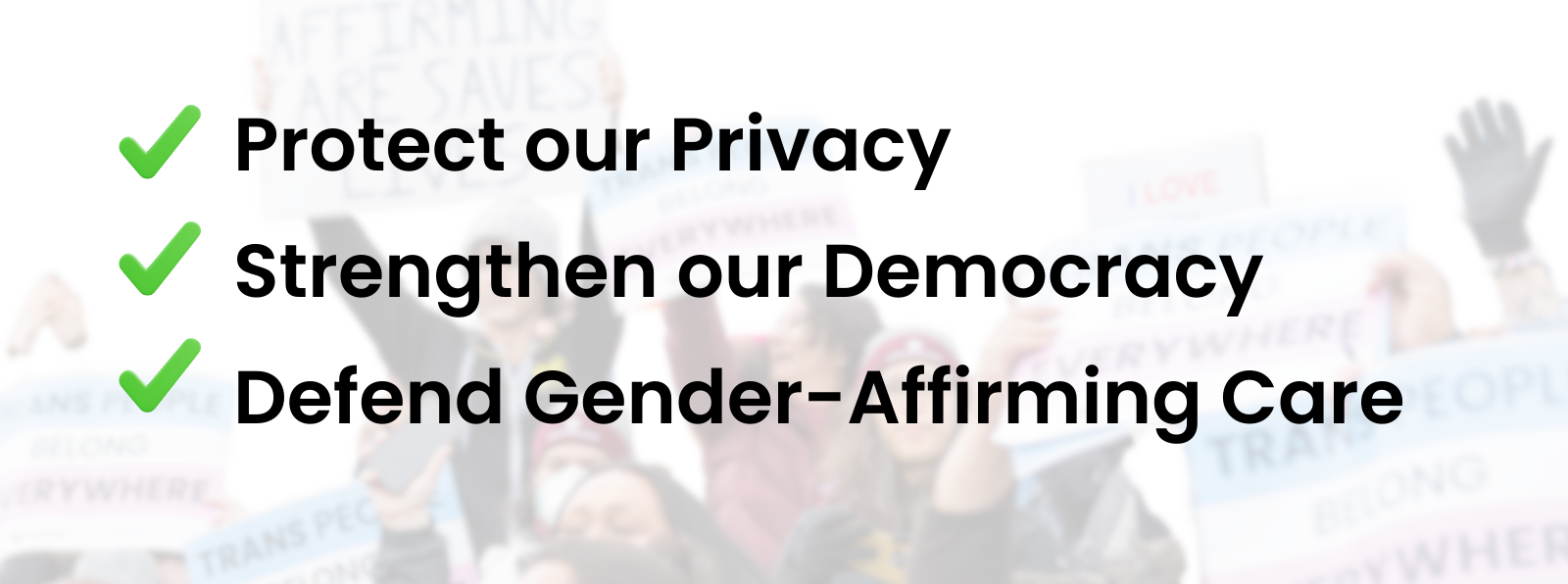
This legislative session, Gender Justice League is focused on a core truth: Trans people deserve privacy, safety, and a real say in the decisions that shape our lives.
This year, lawmakers across the country have increasingly used surveillance, data exposure, and exclusionary policies to target marginalized communities—especially Trans people seeking healthcare, safety, and the right to keep our sensitive personal data private. In response, our 2026 legislative priorities focus on safeguarding personal data, limiting dangerous state surveillance, and expanding fair representation in our democracy.
Note: ☠️ indicates the bill is dead.
Our Top Priority Bills
⭐️ Protecting Privacy, Fighting Surveillance
SB 6081 (Pro) – Protecting Privacy of Sex Designation Information
Public access to sensitive personal data puts people in danger. SB 6081 creates a public records exemption for sex designation information—including historical changes—in state records such as vital records and Department of Licensing files.
For Trans people, exposure of gender history is not abstract—it increases the risk of harassment, discrimination, and violence. This bill is about preventing harm before it happens and reinforcing Washington’s commitment to equity, dignity, and personal safety for all.
SB 6002 / HB 2332 (Pro) – Healthcare Autonomy + Freedom of Movement: Driver Privacy + ALPRs
Automated License Plate Readers allow the state to collect, store, and share data about where people go and when. Without guardrails, this technology can be used to track the movements of marginalized people—especially those seeking gender-affirming care or abortion in Washington State, where it is legal. These protections are vital for healthcare privacy and personal autonomy. We have seen a major surge in “Flock” cameras, which have been misused against community members.
These companion bills limit how ALPR data can be collected, retained, and shared. Protecting driver privacy is about healthcare autonomy, freedom of movement, and resisting over-surveillance.
⭐️ Strengthening Democracy
HB 2210 (Pro) – Our Democracy, Our Voice
Democracy works best when it reflects the people it serves. HB 2210 clarifies the process for cities to adopt alternative voting systems, like ranked-choice voting, that better represent diverse communities.
Fair local governance isn’t theoretical—it determines access to housing, healthcare, public safety, and civil rights. This bill helps ensure that Trans voices count in the decisions that affect our lives.
Other Key Bills for 2026
Gender Justice League remains actively engaged in advocacy on a wide range of bills that affect the safety, dignity, and freedom of our communities.
⭐️ Protecting Access to Healthcare + Privacy
HB 1881 / SB 5704 (Pro) – Protecting Access to Gender-Affirming Healthcare
These bills aim to protect access to care by increasing state review of healthcare mergers and acquisitions. For Trans communities, consolidation can mean fewer providers, longer wait times, and reduced access to gender-affirming care.
☠️ HB 1038 (Con) – Restricting Access to Gender-Affirming Healthcare
This bill would have prohibited healthcare providers from providing or referring Trans youth to gender-affirming care (while carving out exceptions for cis youth for certain medical needs).
HB 2176 (Pro) – Protecting Medical Privacy
This bill exempts information contained in collaborative drug therapy agreements from disclosure under the Public Records Act. Public disclosure of sensitive medical-related agreements can create unnecessary privacy risks and also discourage providers from offering care. For Trans people navigating healthcare systems, privacy protections are not optional—they are essential. HB 2176 helps ensure that medical collaboration happens safely and without exposing patients or providers to harassment.
⭐️ Protecting Trans Youth
☠️ SB 5012 + SB 5097 (Con) – Anti-Trans School Sports Bills
These bills sought to exclude Trans students from participating fully in school sports. While they are dead this session, they reflect a broader national strategy to target Trans youth through schools and sports participation.
⭐️ Funding for Survivor Services
SB 5256 / HB 2289: (Pro) – Funding for Survivor Services
Survivor/victim service providers across Washington are facing a funding crisis driven by steep declines in federal support. Many programs are at risk of closing or significantly reducing services, creating serious barriers for survivors seeking safety and support. Many LGBTQ+ youth organizations and Trans-specific services utilize these funds to support victims of crime, hate crimes, and domestic violence. They are a vital lifeline of support for people in extremely dangerous situations.
Currently, the state budget covers only about half of what is needed to sustain basic survivor services. We are asking the legislature to invest $21.38 million and to work with us to establish a stable, long-term funding solution for survivors/victims of crimes and domestic violence.
⭐️ Digital Privacy, Surveillance, + Criminalization
☠️ HB 2112 + HB 1834 / SB 5708 (Con) – Anti-LGBTQ+ Online Censorship
These bills would have established a minimum age to access certain online content, some of which proposed age-verification requirements (HB 1834/SB 5708) that would have increased surveillance of all WA youth. Though framed as a child safety measure, these bills relied on broad definitions of “adult content” that could include gender education, LGBTQ+ resources, and information about Trans identities. Across the country, similar bills have been used to block access to LGBTQ+ affirming content and restrict educational materials, while labeling Trans existence itself as inappropriate and harmful.
☠️ HB 2526 (Con) – Increased Penalties re: Sex Work
This bill would have further criminalized sex work by expanding the definition of what counts as sex work, and by increasing the penalty for being a client of a sex worker to a felony. Criminalization policies like this disproportionately harm Trans people—especially Trans women and Trans people of color—who already face over-policing and systemic discrimination.
⭐️ Economic Justice
☠️ HB 2100 / SB 6093 / SB 5797 / HB 1687 (Pro) – Progressive Revenue Proposals
These bills explored new revenue streams to fund public goods. Economic justice is inseparable from gender justice, and we continue to advocate for policies that invest in housing, healthcare, and social services rather than surveillance and punishment.
⭐️ Accountability + Civil Rights
SB 6239 (Con) – Limiting Options for Survivors in Foster Care
This bill would limit the ability of survivors of sexual assault in foster care to pursue legal accountability. LGBTQ+ youth—especially Trans youth—are disproportionately represented in foster care and face elevated rates of abuse and exploitation. Limiting survivors’ access to justice only compounds that harm. Survivors deserve pathways to justice, not additional barriers.
☠️ HB 2597 (Pro) – Holding ICE Accountable
This bill would have established remedies for individuals whose constitutional rights are violated during immigration enforcement actions. This bill would have affirmed that constitutional protections do not disappear during immigration enforcement—particularly important for Trans immigrants who are especially targeted and vulnerable—and that civil rights must apply to everyone.
☠️ HB 2293 (Pro) – No Abusive Policing in WA
This bill would have prohibited Washington law enforcement agencies from training with certain foreign entities associated with human rights violations. Communities that already face disproportionate policing—especially Trans people, immigrants, and people of color—are deeply impacted by the tactics and frameworks used in law enforcement training. Washington should not legitimize or import training models tied to documented abuses. Public safety must be rooted in accountability and human rights—not militarization or harmful international partnerships.
☠️ HB 1499 (Pro) – Ending Punishment by Debt
Legal financial obligations (LFOs) often trap low-income people in cycles of debt long after a court case ends. This bill would have addressed burdensome court-imposed financial penalties that disproportionately impact marginalized communities. Trans people disproportionately face higher rates of both poverty and criminalization. Excessive court fines and fees compound economic instability and can lead to further legal consequences. Economic justice is gender justice. Reforming LFOs helps break cycles of punishment tied to poverty.
☠️ HB 1909 (Pro) – Improving Access + Equity in Our Courts
HB 1909 would have created a task force to examine the court system structure and explore potential unification reforms. Washington’s court system can be confusing, inconsistent, and inaccessible—especially for people navigating name changes, protection orders, housing disputes, or criminal legal matters. A more unified and accessible court system could reduce barriers and improve equity. For Trans people who frequently interact with courts for identity documentation or protections from violence, clarity and accessibility are essential.
Your Voice Matters
Gender Justice League is fighting for privacy without exception, safety without surveillance, and a democracy that actually represents us—and we’re just getting started.
Your advocacy—every hearing, testimony, letter, email, phone call, conversation—sends a message that Trans people and our allies are watching, organizing, and refusing to be erased.
Trans Advocacy Day is one of the ways we show up as a community to fight this fight. Every year, we bring Trans people and allies to the state capitol to meet face-to-face with our representatives and advocate for the issues that matter to us.
They bet on fear. We bet on us.
Community donors fund 100% of our advocacy work, allowing us to continue fighting for and winning policies in defense of Trans life. If you can, please consider making a gift today:
Give to GJL Give to Trans Advocacy Day 2026